


Introduction
If you’ve read my blog on Generative Engine Optimization or the follow-up on How to Optimize for AI Overviews, you already know how important it is to get cited in AI Overviews to stand out in today’s search environment.
But here’s the real problem: Most SEO tools and reporting dashboards don’t tell you whether you’re being cited in AI Overviews. And most marketers? They’re still chasing blue links.
So in this post, I want to show you the tools and metrics I use, both for my clients and for PDMA, to actually get cited in AI Overviews and prove it.
Why Most SEO Tools Don’t Account for AI Overviews (Yet)
Traditional SEO tools focus on search rankings, impressions, and clicks. Helpful, but outdated if you’re optimizing for AI-generated visibility.
Google’s AI Overviews pull content based on:
-
Answer clarity
-
Schema compliance
-
Topical depth
-
Trust signals
…not just keyword rankings or backlinks.
And while Google has started surfacing some AI-related data in Search Console, most platforms are still behind. That’s why you need a hybrid tech stack, part traditional SEO (part AI search visibility) to really stay ahead.
7 Tools to Help You Rank in AI Overviews (and Prove It)
1. Google Search Console (with AI Overview tracking)
You’re probably already using Search Console. But now it’s evolving.
As of 2025, Google is testing features that show AI Overview impressions and clicks in certain verticals. While the rollout isn’t universal, you can still:
-
Track how often a page appears for target queries
-
Compare URL performance over time
-
Identify sudden increases in impressions without a jump in clicks (a GEO signal)
Pro Tip: Use the Search Appearance filters (when available) to isolate AI-specific data.
2. Bing Webmaster Tools (for ChatGPT and Copilot visibility)
It might feel odd to look at Bing in a Google-focused blog…but stay with me.
ChatGPT’s browsing is still powered by Bing in many use cases, especially through Copilot, Edge, and third-party integrations. That means optimizing for Bing can indirectly impact AI chat citations across multiple platforms.
Use it to:
-
Submit sitemaps
-
Check crawl and indexing issues
-
Monitor how schema is interpreted
3. Rank Math or Yoast (for Schema + GEO readiness)
If you’re not using BlogPosting schema, you’re falling behind.
Both Rank Math and Yoast make it dead simple to:
-
Add
BlogPostingorArticleschema to every post -
Customize structured data for better crawlability
-
Control title, meta, and canonical settings
If Google can’t understand your post technically, it’s unlikely to trust you as a source for generative answers.
4. SEMrush or Ahrefs (for topical authority building)
Want to get cited more often in AI Overviews? Build authority around a topic, not just a single post.
I use SEMrush and Ahrefs to:
-
Analyze topic clusters
-
Run content gap reports
-
Map internal linking opportunities
-
Benchmark what competitors aren’t covering
This is how you feed AI engines a clean, complete narrative across multiple pages.
5. Clearscope or Frase (for AI-friendly formatting)
These tools don’t just help you “rank” they help you write for machines.
Frase is especially useful if you write in Q&A format. It shows:
-
NLP keyword coverage
-
Competitive structure analysis
-
Gaps in how you’re answering common user queries
I use it to format blogs with questions as H2s and H3s because that’s what Google’s AI model likes to pull from.
6. Validate Schema to Get Cited in AI Overviews
Even if you’re using schema plugins, test your output.
Google’s Schema Markup Validator helps you:
-
Spot broken JSON-LD or missing properties
-
Confirm structured data matches what’s visible on-page
-
Avoid schema spam penalties
One broken tag can be the difference between citation and invisibility.
7. Visual Tracking Tools (screenshots or SERP monitors)
Honestly? The best way to prove you’re in an AI Overview right now is still manual:
-
Search your keyphrase in incognito mode
-
Check if your content appears under the AI-generated paragraph
-
Take a screenshot and log the date
If you want to automate this a bit, tools like SERPWatcher or SEOTesting can help you monitor broader patterns but I still keep a folder of screenshots for client reporting.
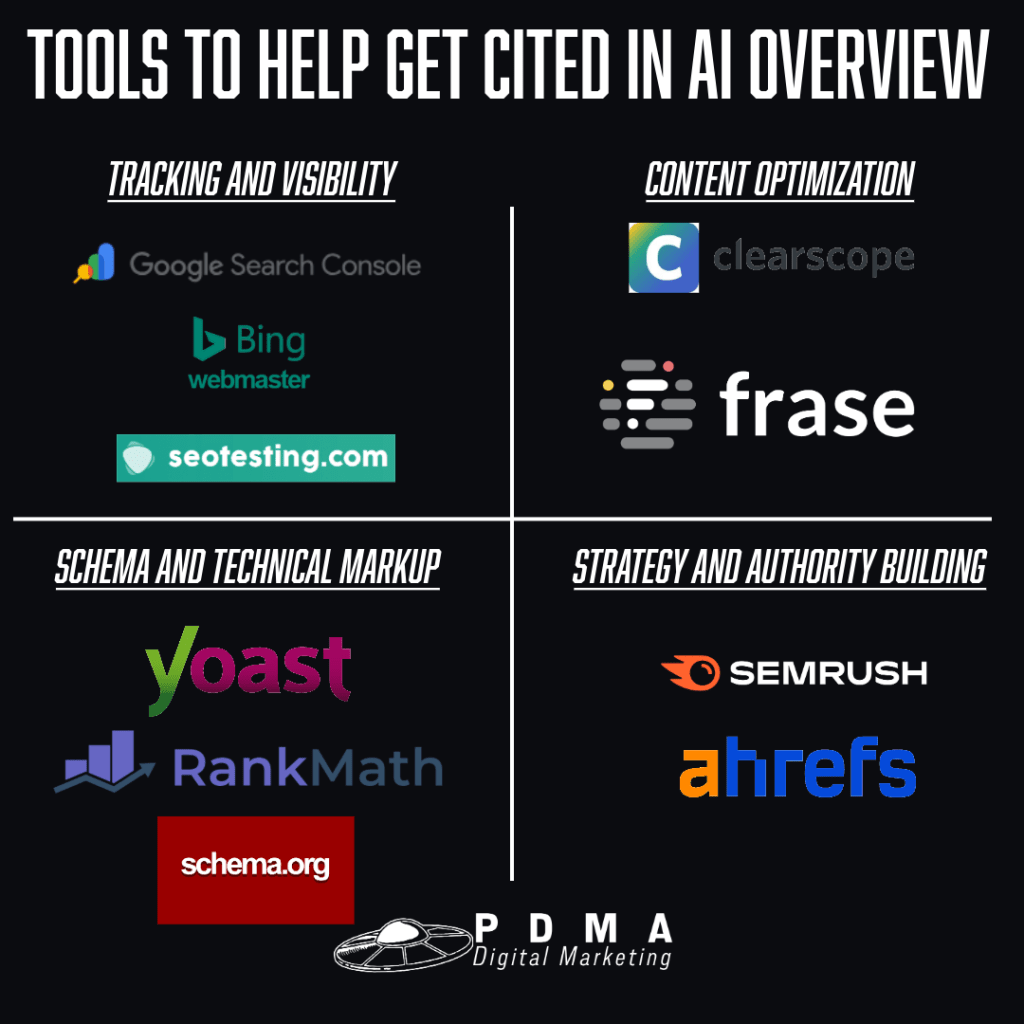
A breakdown of the tools I use at PDMA Digital Marketing to help clients get cited in Google’s AI Overviews organized by their role in tracking visibility, optimizing content, applying schema, and building authority across topics.
How We Helped a Client Get Cited in AI Overviews
At PDMA Digital Marketing, I’ve used this exact stack schema plugins, AI-aware content tools, and manual tracking to get clients ranked in AI Overviews.
In one case, a blog I helped structure not only appeared in the AI-generated answer and it also occupied the top 3 citation links underneath the summary. That’s the rectangle at the top of the page that most users never scroll past.
We didn’t get there by chasing keywords. We got there by:
-
Using BlogPosting schema
-
Writing clean, direct answers to specific questions
-
Building a content cluster that signaled topical authority
This stuff works.
How GEO, AEO, and Traditional SEO Work Together
Quick refresher:
| Acronym | Focus | Example |
|---|---|---|
| SEO | Rankings in search results | Position #1 on page |
| AEO | Answer Engine Optimization | Voice results, featured snippets |
| GEO | Generative Engine Optimization | Citations in Google AI Overviews, Gemini, Perplexity, ChatGPT |
The future of search isn’t about choosing one. It’s about layering all three:
-
Use schema and semantic structure (GEO)
-
Answer common questions directly (AEO)
-
Still monitor rankings and traffic (SEO)
That’s how you future-proof your content.
Final Thoughts: It’s Not Just About Ranking Anymore
You can be the best answer on the internet and still miss traffic if you’re not structured for visibility in AI Overviews.
It’s not enough to write good content you have to make it generative-ready.
If you’re still just tracking keyword positions and organic clicks, you’re missing the bigger picture. These tools help bridge that gap so you’re not flying blind.
Ready to Step Up Your SEO, AEO and GEO game?
Want to know if your blog is ready for AI visibility?
Book a free audit with PDMA and let’s find out what Google’s generative engine sees.

2 Comments