


What Are AI Overviews (and Why Do They Matter in 2025)?
This post is a follow-up to my recent guide on Generative Engine Optimization (GEO). If that post broke down the big-picture shift in how AI is changing search and how to optimize for AI overviews. This one focuses on the most visible part of that change: Google’s AI Overviews.
If you’ve Googled a question lately and found your answer right at the top, without even needing to scroll, you’ve seen an AI Overview.
These AI-generated summaries are Google’s latest evolution in search, powered by its Gemini large language model. Instead of showing you a list of links, Google now gives you a curated answer and hand-picked citations, all bundled into a neat little box. These results dominate attention. In fact, they’re often the only thing users see before deciding what to click (if they click anything at all).
That’s the world we’re operating in now. And if your content isn’t structured for inclusion in these Overviews, your SEO may be doing less work than you think.
Why Traditional SEO Alone Doesn’t Cut It Anymore
Ranking on page one doesn’t mean what it used to.
Google’s AI Overviews frequently pull content from sources that aren’t ranked #1, or even on page one at all. These AI-generated summaries are driven by a different logic: clarity, completeness, topical authority, and trustworthiness. In other words, it’s not just about keywords and backlinks anymore, it’s about usefulness in context.
Enter Generative Engine Optimization (GEO). This emerging practice focuses on shaping content that AI models understand, summarize, and cite. It doesn’t replace SEO but it extends it into the future of search.
6 Ways to Optimize for AI Overviews
1. Use a Conversational Q&A Structure
If you want to get picked up by AI models, write the way people speak.
That means turning your headers into actual questions:
-
What is [your topic]?
-
How does [your product] work?
-
Should I choose X or Y?
You’re not just trying to help Google understand your page, you’re helping its AI answer engines find the exact sentence that satisfies a user query. Questions guide structure, increase skimmability, and mirror how people interact with tools like ChatGPT and voice assistants.
2. Lead With Clear, Concise Answers
Don’t bury the lead.
Start each section, or the whole post, with a short, direct answer to the main question. Think in terms of one or two crisp sentences that AI could lift directly into its summary.
Here’s an example from this post:
AI Overviews are Google’s generative summaries that appear at the top of search results, providing instant answers pulled from high-quality sources.
That kind of sentence structure is what makes content “snippetable.”
3. Implement BlogPosting Schema
Google still needs structure to interpret your content and structured data helps with that.
Use Article or BlogPosting schema on every post. This gives AI systems extra context: who wrote it, when it was published, what it’s about, and how it fits into the broader site.
4. Strengthen E-E-A-T Signals
Google wants content written by people with Experience, Expertise, Authoritativeness, and Trust (E-E-A-T). So give it those signals.
Here’s how:
-
Include an author name and short bio (especially if you have credentials).
-
Add original insights, quotes, or even client case studies.
-
Reference reputable sources and link to them clearly.
AI Overviews often cite sources that clearly show who wrote them, what makes them qualified, and how they support the user’s intent.
5. Build Topical Authority
One-off posts don’t cut it anymore. You need clusters.
Instead of writing a single blog about “How to Optimize for AI Overviews,” build around it:
-
What is GEO?
-
How Google’s AI Overviews Work
-
GEO vs. Traditional SEO
-
Tools to Monitor AI Search Visibility
Link these posts together internally, using natural anchor text. This helps AI engines understand that you’re not just publishing content, you’re building expertise and can optimize for AI overviews.
6. Track How You’re Optimizing for AI Overviews in Search Console
Google is starting to roll out AI Overview performance data in Search Console. While it’s still limited, you can track impressions and clicks specifically from AI answers in some verticals.
Also try this: search one of your keyphrases on Google in incognito mode. If an AI Overview shows up, check if your site is linked underneath. If it’s not, review the content that is getting cited. What do they do differently? How do they structure their answers?
GEO is still young but it’s measurable if you know where to look.
Real-World Application: How PDMA Is Using This
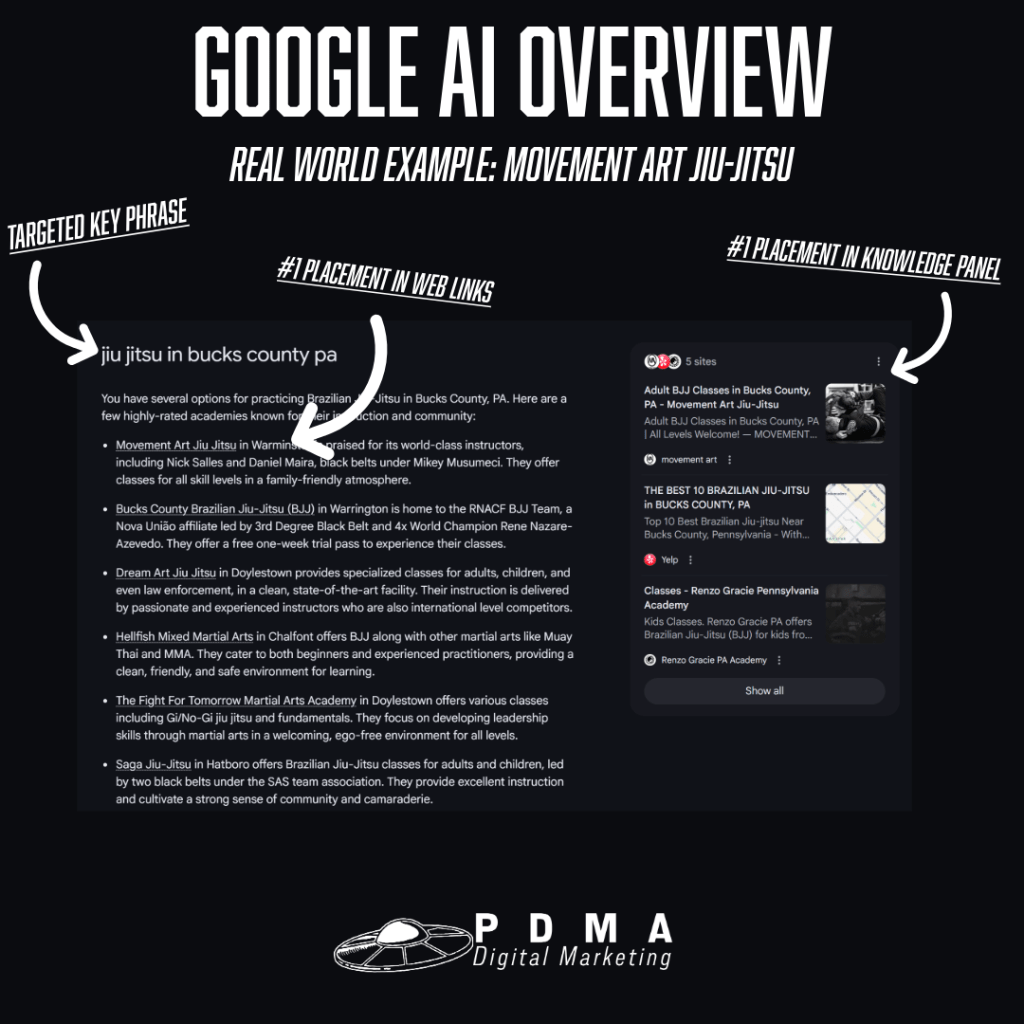
At PDMA Digital Marketing, I’ve been using these strategies with clients and my own content. The biggest win so far?
Owning nearly the entire Google AI Overview blurb for a competitive keyphrase including the top 3 cited links in that rectangular AI box at the top of the page.
That didn’t happen by accident. It happened because the content was:
-
Structured like a conversation
-
Optimized with schema
-
Linked to supporting posts
-
Written with clarity and authority
These aren’t just theories, they’re producing real visibility in the places that matter right now.
Final Thoughts: SEO Is Changing So Don’t Get Left Behind
SEO isn’t dead. But it’s evolving.
If you’re still optimizing your blog posts like it’s 2018, you’re going to miss the boat. AI Overviews, AI-powered search engines, and chat-style discovery are already here and growing fast.
Learning how to optimize for AI visibility now puts you ahead of 99% of small businesses. And the good news? You don’t have to overhaul everything. You just need to shift your strategy from rankings only to answers first.
Call to Action
Want help getting your content into AI Overviews?
Let’s talk about how we can make your business visible in the search results that actually matter now.
Book a FREE consult here
