


If you’ve been in the SEO game for more than five minutes, you’ve probably heard “make sure you add alt text” at least a hundred times. And yet, most websites either ignore it completely or treat it like a dusty checkbox on the SEO to-do list. In 2025, that’s a huge mistake.
Alt text isn’t just about accessibility anymore (though that’s still critically important). Done right, it’s a direct line into Google Images, Google’s AI Overviews, and even answer engines like ChatGPT, Gemini, and Perplexity. Poor alt text can actively hold you back.
This post is your guide to writing alt text that not only passes the accessibility sniff test but also makes your images work harder for you in both traditional search and AI-driven results.
In this guide to alt text SEO 2025, I’ll show you how to write image descriptions that make your visuals work harder in Google Images, AI Overviews, and answer engines.
Much of what I discuss in this article comes directly from Google’s Image SEO Best Practices and I’d recommend taking a look at it for yourself.
Why Alt Text Still Matters in 2025
Let’s start with a myth: “Google’s AI can recognize images now, so alt text doesn’t matter.” That’s… kind of like saying “cars have GPS, so I don’t need road signs.”
Google’s vision AI is powerful, yes—but it still leans heavily on the textual context you provide. The alt text you write becomes part of the data Google uses to understand the image’s meaning and relevance. And with AI Overviews and other answer engines pulling information from across the web, your alt text could be what gets your brand mentioned—or ignored.
The Core Job of Alt Text
1. Accessibility: Describe the image for users who can’t see it.
2. SEO: Give search engines context to rank your image in Google Images and use it in SERPs.
3. AI Discoverability: Provide rich, relevant descriptions that generative search tools can interpret and surface.
How to Write Alt Text SEO 2025 Google and AI Will Love
1. Describe the Image Accurately
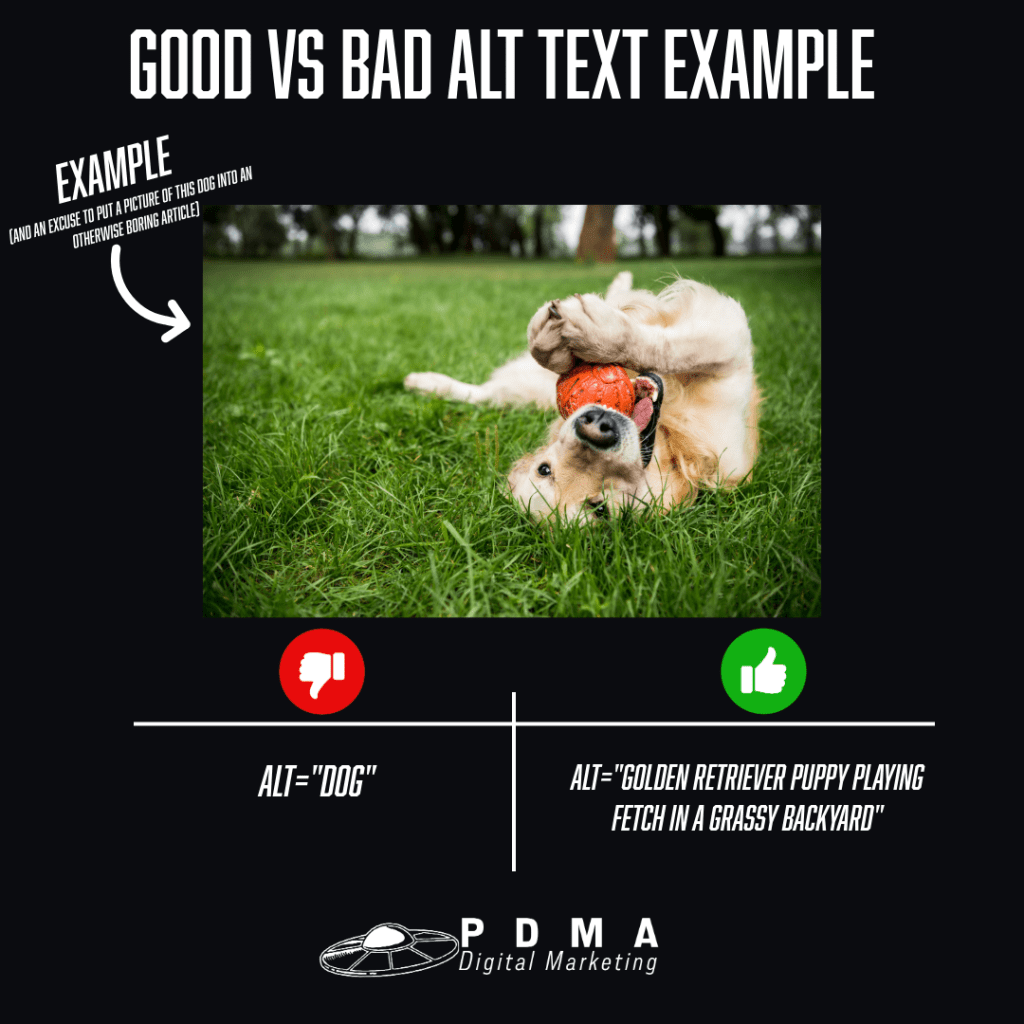
Be specific. Instead of alt="dog", write alt="Golden retriever puppy playing fetch in a grassy backyard".
2. Add Context From the Page
If that puppy image is on a pet adoption page, your alt text might be:alt="Golden retriever puppy available for adoption at [Shelter Name] in Philadelphia"
3. Use Natural Language, Not Keyword Dumps
Google can smell keyword stuffing a mile away. Alt text like:alt="SEO, image SEO, Google SEO, AI SEO, best SEO 2025" will do you no favors.
4. Include Relevant Keywords in Alt Text SEO 2025
Your primary keyword should be in the alt text if it belongs there naturally.
5. Mind the Length
Aim for 5–15 words. Long enough to be descriptive, short enough to be scannable.
Moz’s Alt Text Guide is very helpful as a reference here.
The AI Angle: Why Alt Text is Your Secret Weapon in Generative Search
Here’s where it gets interesting. Tools like Google’s AI Overviews, ChatGPT browsing, and Perplexity sometimes use image descriptions in their generated answers.
For example: If someone asks “What does the seating area at Café ABC look like?” and your site has an image with alt text Cozy seating area at Café ABC with wooden tables and vintage decor, AI could pull that description word-for-word. Without alt text, that detail never makes it into the answer.
Real Examples From My Work at PDMA
At PDMA, I’ve used strategic alt text as part of Generative Engine Optimization (GEO) campaigns for clients. One of my proudest wins? Owning nearly the entire Google AI Overview blurb for certain target phrases, including all three top web links in that big rectangle on the right-hand side of the page.
While alt text wasn’t the only factor, it was one of the foundational elements that made our images eligible to be shown and referenced.
Your Alt Text Quick-Start Checklist
-
Every important image has alt text.
-
The description is accurate and specific.
-
Page context is included where relevant.
-
Keywords appear naturally, not forced.
-
Decorative images use empty alt (
alt=""). -
File names match the image’s topic (hyphen-separated).
-
Structured data includes the
imageproperty where applicable.
Final Takeaway
Alt text is one of those small SEO details that quietly pays huge dividends if you take the time to do it right. In 2025, it’s not just about showing up in Google Images; it’s about making your visuals part of the conversation in both human search and AI-driven results. When you follow these alt text SEO 2025 best practices, your images don’t just sit on your site, they show up where your customers are actually searching.
So, the next time you upload an image, ask yourself: “If this picture had to speak for itself in a Google search or AI answer… what would I want it to say?”
Let’s Talk About Your Image SEO (CTA Section)
Most websites treat image optimization as an afterthought and that’s why they’re invisible in Google Images and AI Overviews. At PDMA Digital Marketing, I help businesses turn their visuals into traffic and conversion magnets using proven SEO and Generative Engine Optimization techniques.
Book a free consult to find out how we can make your images (and your brand) impossible to ignore.

One Comment