


Defense tech companies are cool now?! For most of history, defense tech marketing didn’t exist in any modern sense. The big primes didn’t focus much energy on branding or storytelling, and they didn’t need to. But something has changed and it’s not subtle.
A new wave of defense tech companies like Anduril, Shield AI, Saronic and more have flipped the script entirely. They’ve embraced modern branding, transparent communication, and community-driven marketing in a way this industry has never seen.
These companies aren’t just competing for contracts. They’re competing for talent, influence, and cultural mindshare and their approach to defense tech marketing offers a powerful lesson for businesses in every industry.
The Old Model: Why Defense Tech Marketing Didn’t Matter Before
Before this new wave, legacy defense companies grew by mastering a closed procurement ecosystem. Their “customer” wasn’t the general public or even the warfighter, it was a small number of high-level decision-makers inside the Pentagon and other government agencies.
These were decades-long relationships built on scale, compliance, political influence, and sustaining programs that lasted for generations. Public-facing marketing played almost no role in whether a radar program launched or a missile system got approved.
The formula was simple:
Big company + big bureaucracy + big government = big contracts.
Branding didn’t matter. Content didn’t matter. Storytelling….only kind of mattered.
In other words, defense tech marketing wasn’t a thing because there was no competitive advantage in being understood by the public. In certain cases, the government would make sure to tell the public just how cool this new weapon system was.
How the Ukraine War Changed Defense Tech Procurement
The Ukraine war changed everything.
For the first time, major purchasing decisions weren’t just coming from the top. They were moving down the chain of command. I could write an entire book on how the Ukranian military is setting a new standard for battlefield logistics but here’s what you need to know for the purposes of this article. Not long after the war started, Ukrainian field-grade officers began selecting drones, sensors, software, and autonomous systems based on performance, speed, and publicly available information and not decade-long procurement cycles.
Warfare moved too quickly for traditional acquisition. Tools needed to be purchased, deployed, iterated on, and replaced in weeks, sometimes days.
And here’s the marketing insight most people miss:
When end users gain real decision-making power, storytelling becomes a competitive advantage.
Companies with clear demos, public explanations, transparent leadership, and accessible content suddenly held a major edge. This is where modern defense tech marketing began, not with ads, but with clarity.
The Center for Strategic & International Studies has a great article on this topic if you’d like to learn more.
The GWOT Gear Companies That Pioneered Modern Defense Tech Marketing
As a GWOT-era veteran, this shift feels familiar. Long before drones, AI autonomy, and software modernization became the center of attention, the cool guy gear companies were already rewriting the rules.
Brands like Spiritus Systems built huge communities on YouTube and Instagram with cinematic product videos and operator-focused messaging. They didn’t speak like corporate vendors, they spoke like the warfighters who actually used their products.
Ferro Concepts mastered simple, clean branding that resonated with the end user. Their content made their gear feel accessible, reliable, and part of a professional identity.
And we’re not going to forget about the grandfather of brand storytelling in the warfighting space, 5.11. That’s right, those tattered hiking pants you see on every backwoods town’s bar seat were once the uniform of highest speed dudes in Baghdad.
This created a powerful dynamic:
They sold B2C, but influenced B2G.
A service member bought a chest rig → teammates used it → eventually the unit placed an order. Bottom-up procurement powered by brand affinity.
And then there was Crye Precision, the most iconic example of gear-driven identity in modern military culture. Crye didn’t just make uniforms. They built an aura. Everyone knew “cool guys wore Crye,” and Crye made sure that brand perception stayed alive.
If today’s software and autonomy companies look cooler than the old primes, it’s because the warfighter gear brands paved the way. They were the first real innovators in defense tech marketing, even if their products weren’t “tech” in the traditional sense.
The New Era of Defense Tech Companies and Their Marketing Strategy
Anduril’s Founder-Led Marketing Approach
Anduril didn’t try to blend in with defense giants, they positioned themselves as the disruptive, Silicon Valley-inspired alternative. Their branding feels more like Tesla meets SpaceX than a defense contractor.
Founder Palmer Luckey amplified this by embracing high-visibility media. He appeared on The Shawn Ryan Show, The Joe Rogan Experience, and other major podcasts and openly explained autonomy, strategy, procurement challenges, and modern warfare in plain language.
That authenticity is a masterclass in defense tech marketing.
Shield AI and the Rise of Transparent Defense Branding
Shield AI follows the same playbook. Instead of hiding behind corporate silence, their leadership speaks directly to the public.
Most notably, Shield AI’s President and Co-Founder Brandon Tseng appeared on The Shawn Ryan Show, discussing AI pilots, autonomous aviation, ethics, and the future of combat aviation. Brandon also brought along with him a scale model of one of the company’s products, a massive batman like drone that’s currently being utilized by the US military. If you want to show the world how cool your company is, dropping a UFO that you built onto a lawn in Tennessee is a good way to do it.
In a field where companies used to avoid public conversation entirely, Shield AI leans into transparency and that transparency has become one of their strongest brand assets.
This makes them not just a defense contractor but a trusted voice in a complex, evolving conversation.
Saronic: Making Autonomous Sea Power Understandable
On the maritime side, Saronic is doing something similar with autonomous surface vessels.
Co-Founder and CEO Dino Mavrookas appeared on The Shawn Ryan Show, offering one of the clearest explanations of how autonomous sea vehicles will shape the future of naval operations. He talked openly about challenges, mission profiles, and why sea autonomy matters all in plain, accessible language.
Saronic’s branding is modern, clean, and rooted in clear communication. They show the vessels. They show the mission. They explain the stakes.
And that’s what modern defense storytelling looks like.
Cool Branding in Defense Tech: What We Can Learn From Defense Unicorns
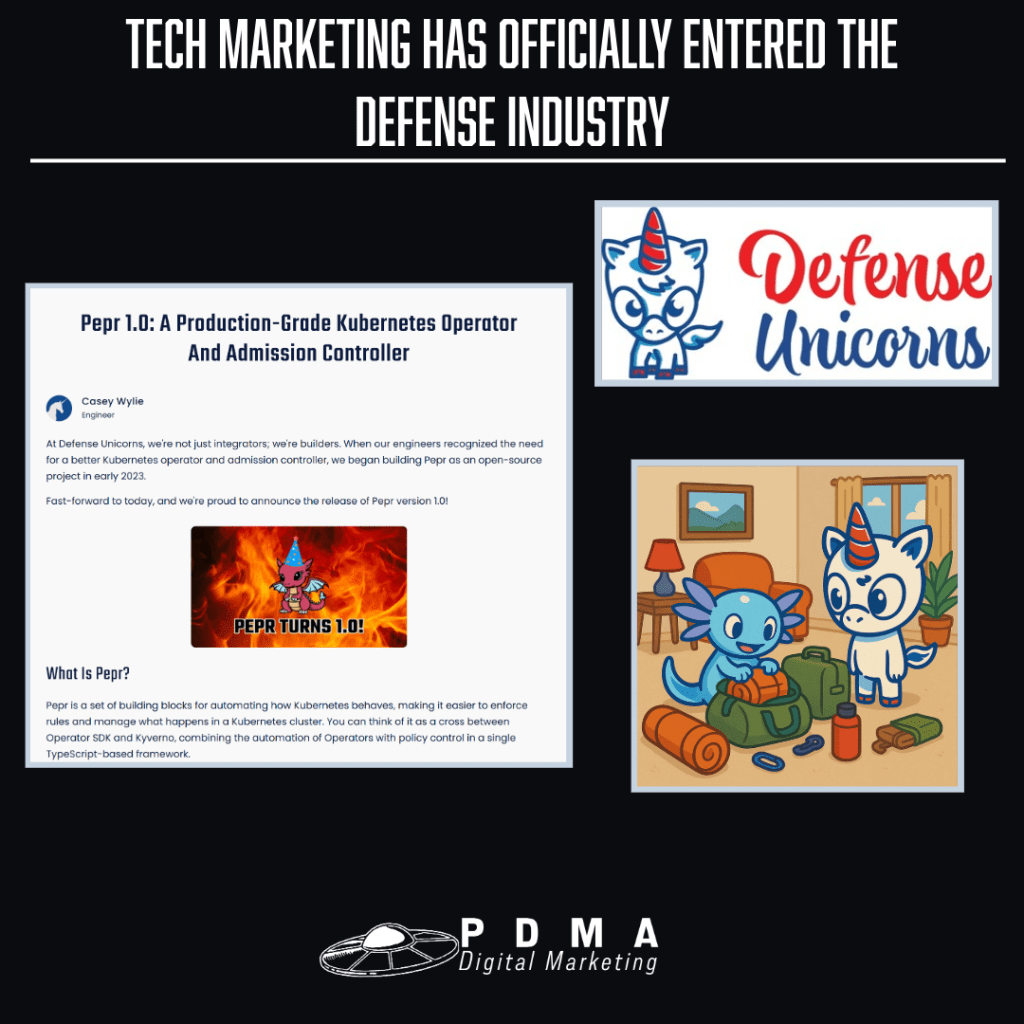
No company highlights this shift better than small software company called Defense Unicorns.
Their branding is intentionally playful, cartoon unicorns, cryptids, bright palettes, friendly typography, all paired with tanks, jets, and national security language. It sounds absurd, but it works beautifully.
Defense Unicorns builds serious software for serious missions, but their branding signals:
• creativity
• innovation
• culture
• approachability
• and a break from “Pentagon gray” imagery
Raytheon could never adopt a unicorn mascot. Lockheed could never use cartoon cryptids on their homepage.
And that’s exactly the point.
In the battle for engineering talent, public trust, and cultural relevance, Defense Unicorns stands out instantly. Their identity is unforgettable and a brilliant example of differentiated defense tech marketing.
Why Venture Capital Supercharged Modern Defense Tech Marketing
Legacy primes weren’t built by venture capital. They were built by government programs.
The new wave of defense startups, however, is backed by firms like:
• Founders Fund
• a16z
• Lux Capital
• 8VC
These investors don’t just expect technological innovation. They expect brand innovation. They encourage:
• public storytelling
• content ecosystems
• founder visibility
• clear mission narratives
• community building
That VC-driven influence reshaped defense tech marketing into something that looks more like SaaS marketing — fast, public, and mission-driven.
Podcasts and Public Thought Leadership in Defense Technology
Another major shift is where defense leaders choose to speak. Instead of private summits, they’re going on Rogan, Shawn Ryan, Lex Fridman, and other platforms with millions of listeners.
These conversations do something no corporate whitepaper ever could:
• build trust
• reach actual warfighters
• explain complex ideas simply
• humanize the mission
For modern defense companies, podcasts aren’t PR. They’re marketing, recruiting, education, and brand-building all at once.
Marketing Lessons Every Business Can Learn From Defense Tech
1. Transparency builds trust, even in high-stakes industries
If defense companies can explain autonomy publicly, you can explain what you do too.
2. The founder is the brand
People trust people more than logos.
3. Storytelling is more important than ever
Complex = confusing. Confusing = ignored.
4. Community drives adoption
Warfighters talk. So do your customers.
5. Cool branding isn’t fluff; it’s positioning
If Defense Unicorns can do it, so can you.
Conclusion: The Future of Defense Tech Marketing Is a Lesson for Everyone
The defense sector used to be the last place anyone expected to see modern marketing. Now it’s the perfect case study in why brand, story, and transparency matter more than ever.
Anduril, Shield AI, and Saronic didn’t win attention because they shouted louder. They won because they communicated clearly, consistently, and authentically and because they understood that modern defense tech marketing is as much about narrative as it is about innovation.
If the most serious, complex industry in the world can embrace bold branding, founder storytelling, and public engagement… then any industry can.
Great marketing isn’t about making noise. It’s about making sense.
